19/10/2026 22:13
One Set or Separate Pieces? Telegram Photo Albums for Cambodian Tableware Shops
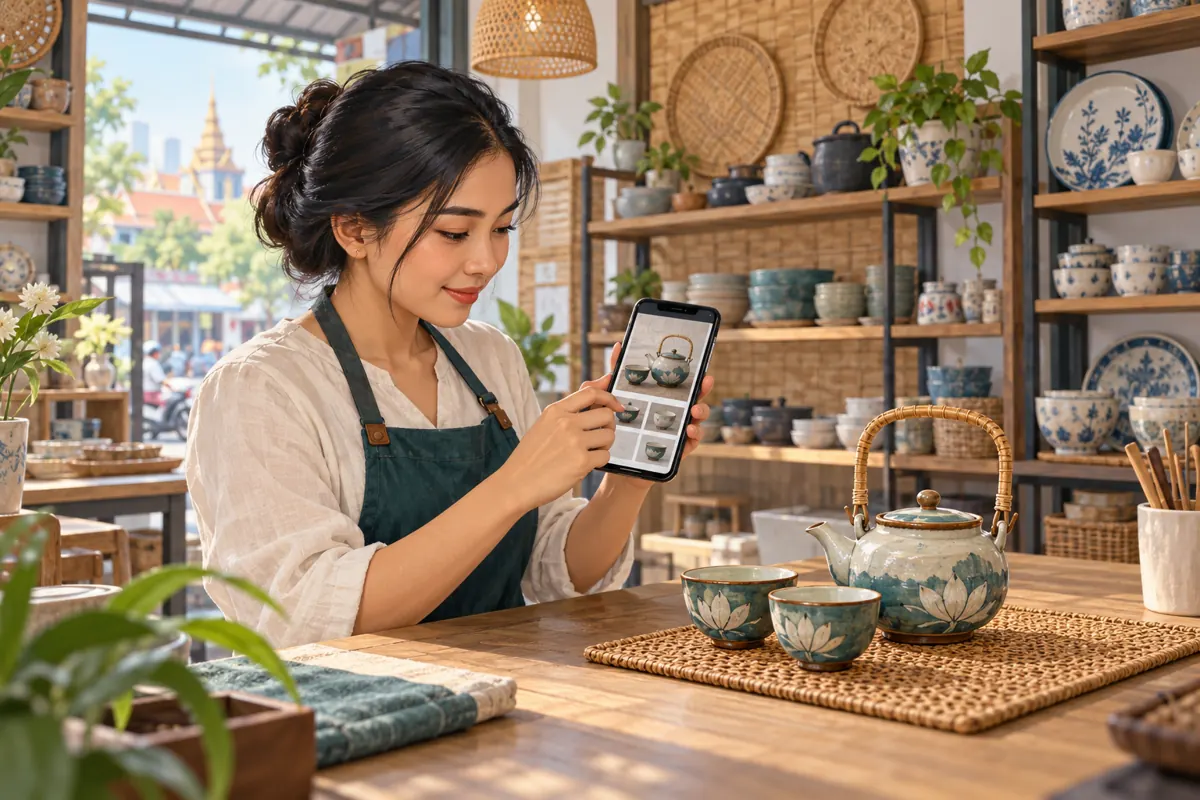
A beautiful table setting can create an awkward sales conversation when a shopper assumes the tray, napkins and extra cups are included. For Cambodian tableware businesses promoting products through Telegram, a useful album should answer a practical question: what exactly can the customer order? This workflow takes one product from the shop counter to a clear sequence of photos, a precise caption and a manageable enquiry. It also explains where an SMM panel listing fits into the decision, without treating purchased membership as evidence that people want the product. The shop scenario and sample wording below are hypothetical.
1. Choose one buying decision for the album
Start by writing the decision the customer needs to make. For a hypothetical Phnom Penh tableware shop, that might be whether a particular teapot-and-cup set suits a small dining table. The album can then show the complete set, useful details and its size. A collection mixing dinner plates, drinking glasses and unrelated serving bowls asks shoppers to solve several different problems at once. Separate those offers when their contents, availability or ordering conditions differ.
Telegram documents media albums containing up to ten photos or videos, with control over selection order. That is a capacity limit, not a target for every product. [Telegram’s album guidance](https://telegram.org/blog/albums-saved-messages) explains the feature. Choose only images that answer a distinct question. This article concerns grouped media in a chat or channel post. Build the album around one understandable offer, even when several attractive products are available to photograph.
2. Define the included pieces before styling the scene
Place the actual sale items on an empty counter and make an internal inventory. Record the product reference, included pieces, colour or finish, and whether additional pieces can be purchased separately. Decide how to describe lids and other components so the piece count is unambiguous. For example, stating “one teapot with lid and two cups” is clearer than relying on “three-piece set” when a shopper might count the lid separately.
Now add any styling props deliberately. In the hypothetical example, a bamboo tray and folded napkin improve the scene but are not included. Photograph the included items alone first, then use the styled arrangement as a supporting image if useful. Put exclusions close to the description of the set. A warning buried after delivery information makes the customer work too hard. If a prop looks central to the offer, removing it may communicate better than adding another sentence.
3. Give each photograph a specific job
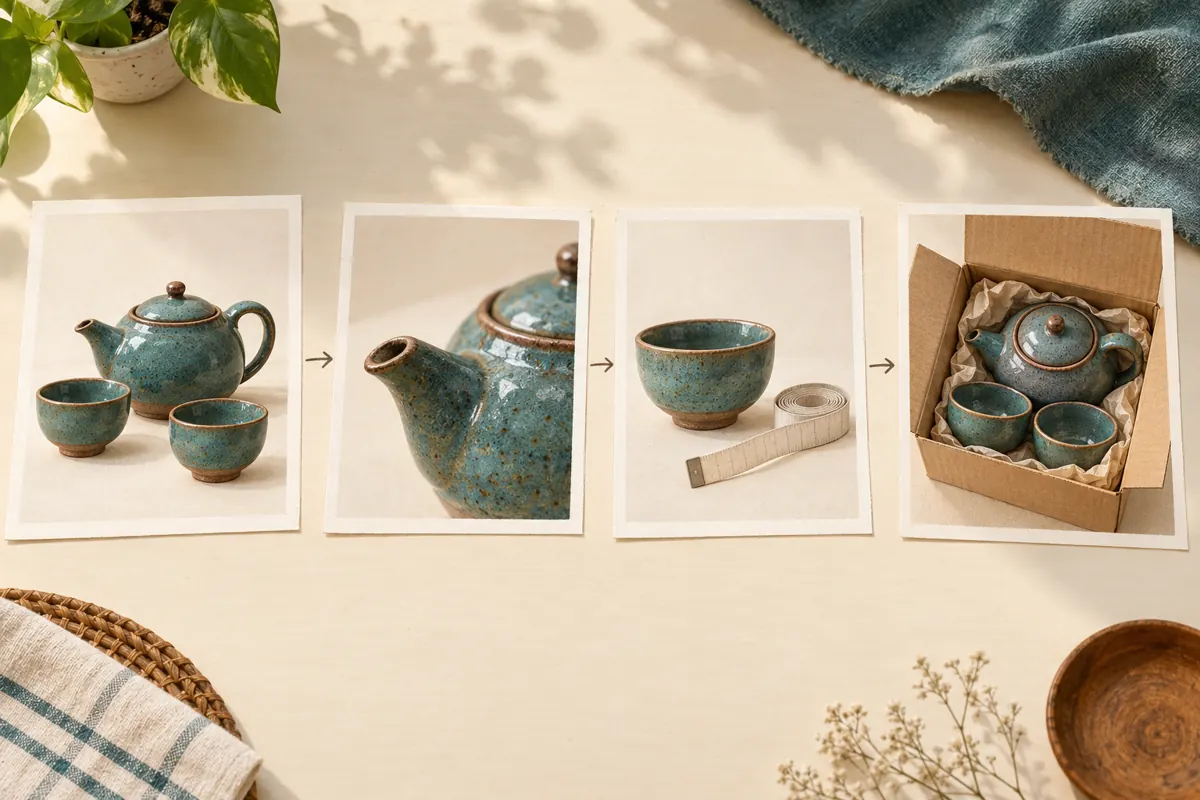
Plan a short sequence before taking dozens of pictures. Begin with the complete offer, with every included piece visible. Follow with the detail a buyer cannot judge from the overview: the spout, handle, rim or surface finish. Add a size reference supported by actual measurements. Finish with packaging only when it helps explain what the shop supplies. These are editorial choices for this scenario, not mandatory Telegram requirements.
Test the sequence by finishing the sentence “this photo helps the shopper understand…” for every image. If two pictures have the same answer, keep the clearer one. A close-up should reveal something useful rather than merely repeat the hero photograph at a tighter crop. Avoid ending with an unrelated premium set, because readers may interpret it as another view of the same offer. Alternative products deserve their own references and clearly separated explanations.
4. Photograph evidence rather than implied promises
Use the same physical set throughout the shoot, and check that replacement pieces have not slipped into the arrangement. Keep lighting reasonably consistent so cream glaze does not appear white in one frame and yellow in another. Include measured dimensions in the product information rather than expecting a hand or nearby object to establish size accurately. Where handmade variation exists, explain what may vary and which pictured details belong to the sample.
Do not turn a photograph into an unsupported performance claim. A cup beside a kettle does not establish heat resistance, and a shipping box does not establish protection against every delivery accident. Describe only properties the shop can substantiate. For Cambodian enquiries involving delivery beyond the shop’s immediate area, prepare a separate answer about packaging and available delivery arrangements. The photographs should help customers inspect the offer; fulfilment terms still need explicit confirmation.

5. Assemble and preview the grouped media
In the intended Telegram chat or channel, open the media attachment picker and select the approved photographs in the planned sequence. Inspect the selection before sending. Telegram’s official attachment guidance describes opening the selected-media preview to rearrange or remove items. Interface details can vary by app version, so use the controls visible in your installation. [Telegram’s attachment-menu explanation](https://telegram.org/blog/downloads-attachments-streaming) supports this preview step.
Check both the overall arrangement and each individual picture. A thumbnail may crop a handle or make two overlapping cups look like one. If the overview depends on a tiny detail, improve the photograph instead of assuming everyone will enlarge it. Remove near-duplicates and accidental gallery selections. A private review chat with an authorised colleague is useful for checking the assembled result before the business publishes it. Keep customer documents and unrelated personal photographs out of the selection.
6. Write a caption that resolves the set question
Open with the product reference and included contents. Then explain the finish, verified dimensions, any important exclusions and the next action. If a price is included, state whether it applies to the whole set or an individual piece and identify the currency. Keep delivery charges or other conditions explicit. A Cambodian shop serving Khmer-speaking customers should prepare the customer-facing wording in language those customers understand, with a competent speaker checking the meaning.
A hypothetical caption might read: “Tea set TS-A: one teapot with lid and two matching cups. The tray and napkin shown in the styled photograph are not included. Message the shop with TS-A, the number of sets required and your pickup or delivery area to check availability.” Add actual dimensions and commercial terms only after confirming them. This structure gives staff a useful opening enquiry while avoiding a premature promise that every requested quantity or destination can be served.
7. Run a buyer-comprehension check
Ask a colleague who did not prepare the album to review it on a phone. Without coaching, ask them to identify the included pieces, excluded props, product reference and next step. Also ask whether they believe the images show one offer or several alternatives. Record misunderstandings in their own words. If they assume the tray is included, the presentation needs work even when an exclusion technically appears somewhere in the caption.
Make the smallest change that resolves the confusion: replace a crowded overview, move the contents statement earlier, or remove an ambiguous accessory. Then repeat the affected question. This is a comprehension check, not proof of market demand or a predicted conversion rate. It is especially useful when one person takes the photos and another handles Telegram messages, because both staff members need to describe the same offer consistently.
8. Decide whether the panel listing addresses the actual problem
The supplied catalogue includes “Telegram - Channel/Group Members ~ Max 1M ~ 200k/days ~ Instant ~ 𝐍𝐎 𝗥𝗘𝗙𝗜𝗟𝗟”. Its name identifies a channel/group membership listing. The brief provides no accompanying description, so the wording does not establish audience location, genuine interest, account quality or verified delivery performance. Treat the other phrases in the title as catalogue labels requiring clarification, not facts to repeat as recommendations.
A membership listing does not answer whether the album explains the product correctly. It also should not be assumed to accept an album link or provide views of particular photographs. If considering it, first establish the accepted target and documented terms through the panel’s normal information channels. Purchased engagement is not evidence of Cambodian users, sales, genuine interest or ad delivery. If the business needs relevant product enquiries, assess promotion by that objective; a larger membership count cannot substitute for it.
Keep any panel order record separate from the product enquiry log. Do not present a change in membership as customer endorsement of the tea set or imply official Telegram affiliation.
9. Prepare the response before promoting the album
Give the person handling enquiries the same product reference and contents list used in the caption. Their first reply should confirm which set the customer means, the quantity requested and the intended pickup or delivery area. Ask for detailed delivery information only when needed to fulfil the request. A product enquiry does not require the customer to post a home address in a public discussion.
For the hypothetical TS-A set, a shopper asking “Can I get four?” could mean four cups or four complete sets. Clarify that unit before quoting or reserving anything. Likewise, a request for the photographed tray should be handled as a separate item if it is available at all. Prepare these answers in advance so the promotion does not create inconsistent promises across staff shifts. Confirm stock, the final order contents and fulfilment arrangements before treating the conversation as an accepted order.
10. Improve the album using the questions it creates
After publishing, review actual enquiries for recurring confusion. Useful notes include “asked whether tray was included,” “needed cup dimensions,” and “could not identify the finish.” These observations tell the shop what information to improve. They do not establish how every viewer interpreted the album. Record completed orders separately, using the business’s normal confirmation process, and avoid assigning every subsequent sale to Telegram without evidence.
Common mistakes include filling every available image slot, mixing several finishes under one vague caption, showing old packaging as current, and changing the offered contents without checking the photographs. Revisit the album when the product changes. If a customer is already discussing an older version, explicitly reconfirm the contents with that customer. Preserve enough internal context to explain what was offered, while keeping the public presentation clear and current. Promotion works more usefully when staff can reliably fulfil the offer people actually saw.

Frequently asked questions
Should every colour go into the same Telegram album?
Only when the comparison remains easy to understand. Give each finish an unmistakable identifier and explain whether contents and conditions are the same. If customers could confuse different sizes, packaging or included pieces, separate albums may be clearer. Do not rely on colour alone to identify an order, because lighting and screens can change its appearance.
Do I need ten photographs to make the album look complete?
No. Completeness means answering the buyer’s important questions. Several near-identical photographs can make the useful detail harder to find. Use a short sequence when the overview, dimensions and one detail explain the offer adequately. Add another image only when you can state what new information it contributes.
Can a styled photograph still be the first image?
Yes, if the offer remains unmistakable. However, when props resemble included merchandise, an uncluttered photograph of the actual contents is usually easier to interpret. Test the image with someone unfamiliar with the product. If they count the tray or extra cups as part of the set, change the image or arrangement before promotion.
What should I do when a shopper sends only one photograph from the set?
Confirm the product reference and restate the included contents before discussing an order. A single image may show only a detail or a styling arrangement. Ask whether the shopper wants the complete set or a particular piece, then explain what the shop actually sells. Never treat the photograph alone as agreement on quantity or price.
Can more panel-supplied members demonstrate that the album is successful?
No. Membership delivery and product interest are different observations. Review whether genuine enquiries identify the product correctly, whether staff can answer them accurately, and whether any orders are actually confirmed. Even these observations need context. A panel count alone cannot establish Cambodian audience relevance, customer satisfaction, sales or the effectiveness of this particular album.
Explore the current service catalogue, create an account, or ask a specific question through support tickets.
- Telegram: Albums, Saved Messages and Better Search
- Telegram: Download Manager, New Attachment Menu, Live Streaming With Other Apps and More
Prepared with AI assistance. Illustrations explain the workflow and do not represent customer results.