21/10/2026 07:26
Did the Voice Note Say Seat Width? Telegram Transcription for Cambodian Cushion Shops

A cushion photograph can attract attention, but the next conversation determines whether a shop understands what the customer needs. A buyer might send a Telegram voice message describing a chair, naming a fabric and mentioning several measurements while standing beside a noisy road. Reading a transcript may help staff identify the subject quickly. It does not establish which number describes the seat width, whether the customer wants a cover or a complete cushion, or whether production has been approved. For Cambodian businesses promoting custom cushions, a useful workflow connects the public demonstration to a private enquiry, then turns that enquiry into a specification the customer can check. Transcription belongs near the beginning of that process.
1. Define the decision before reading the transcript
Consider a hypothetical cushion workshop in Phnom Penh promoting replacement seat cushions for wooden chairs. Its demonstration invites viewers to send a chair photograph and describe what they want changed. A customer responds with a voice message mentioning an existing cushion, a wider seat and a removable cover. Before quoting, staff need to distinguish the furniture dimensions from the desired finished cushion dimensions.
Give each enquiry a simple working status: received, clarification needed, ready for quotation or approved for production. These are shop procedures, not automatic Telegram features. A transcript can help move an enquiry into the clarification stage, but should not move it directly into production. Decide who checks dimensions and who confirms material availability. That division is especially useful when one person answers social messages while another cuts fabric.
2. Check transcription on the account staff actually use
Telegram lists Voice-to-Text Conversion among its Premium features and notes that support can differ between clients. Check the official app and account used at the shop counter before building a daily routine around it. Open a harmless test voice message and look for the available transcription control. Account and client details are explained in the [Telegram Premium FAQ](https://telegram.org/faq_premium).
Non-Premium transcription is subject to configured weekly and message-duration limits, according to Telegram’s technical documentation. Avoid promising staff a fixed free allowance based on an old tutorial; check what their account currently permits. See [Voice message transcription](https://core.telegram.org/api/transcribe). These sources do not establish accuracy for Khmer workshop vocabulary. Test representative speech, including mixed-language fabric names, before relying on the output. If the feature is unavailable, listening and writing a short summary still supports the same confirmation process.
3. Separate the customer’s words from the shop’s interpretation
When transcription is available, use it first to locate the request: replacement foam, new cover, changed shape or another need. Then listen to the original message before recording details that affect price or production. Keep a distinction between what the customer stated and what staff inferred. For example, “customer mentioned a zip” is different from “customer approved a removable zipped cover.” The second statement adds a decision.
Make the working summary compact: requested item, quantity, measurements mentioned, material preference and unresolved questions. Mark unknown details as unknown. Do not fill a missing thickness with the dimensions of a cushion shown in yesterday’s promotional post. If the voice note refers to “this one,” connect it to the relevant photograph or ask which image the customer means. Transcription cannot supply a missing visual reference.
4. Verify dimensions, units and what is being measured
In a hypothetical enquiry, a customer mentions 45, 40 and 5. Those numbers might describe width, depth and thickness in centimetres, but the shop must establish that explicitly. Ask whether the measurements refer to the bare chair seat, the old cushion or the desired replacement. An old compressed cushion may provide a different reference from the chair itself. Avoid treating a plausible interpretation as a confirmed specification.
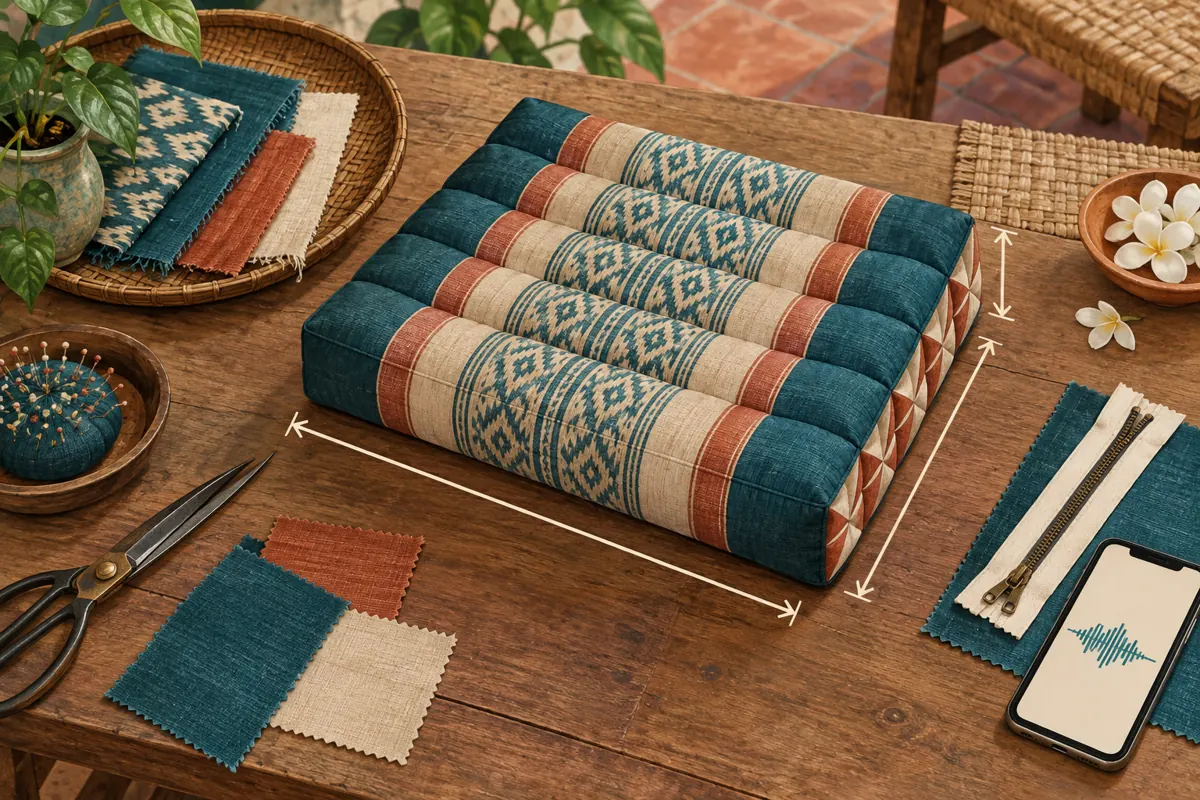
Send a simple sketch showing the front edge, back edge and thickness, then ask the customer to identify each measurement. A useful reply is: “Please confirm the finished cushion width, front-to-back depth and thickness, with the unit beside each value. Is this for the cover only or for the complete cushion?” For shaped or tapered seats, ask for a suitable template or arrange a measurement check. Three numbers alone may not describe the shape.

5. Read back one complete proposal for confirmation
After resolving the questions, send a consolidated summary instead of asking the customer to reconstruct several voice messages. In this hypothetical example, the summary could read: “Proposed item: one complete seat cushion, finished width 45 cm, depth 40 cm, thickness 5 cm, removable zipped cover, fabric sample C. Please confirm these details or tell us what to change.” The sample code and measurements are illustrative, not a product offer.
Keep specifications separate from the commercial agreement. Once the customer confirms the item, explain the actual quotation, collection or delivery arrangement, and any production conditions your shop uses. A reply accepting the dimensions does not necessarily accept the price or collection date. If the customer changes a detail, send a revised consolidated summary and identify the change. The cutter should receive the final confirmed version, not the first transcript.
6. Use a fallback when the words remain uncertain
Choose the next step according to the uncertainty. If a single number is unclear, ask the customer to type that number with its unit. If the reference object is unclear, request a photograph showing the relevant area. If the whole explanation is difficult to follow, arrange a short conversation or an in-person check. Asking for the entire voice message again can create more work without resolving the original ambiguity.
For customers who prefer speaking, read the proposed specification back in their preferred language and ask them to confirm each critical detail. Staff can document that confirmation in the enquiry record. Do not make typing a long message the only route to service. Equally, do not assume a polished transcript means the request is complete. A clear sentence can still omit whether the customer wants new filling or only a replacement cover.
7. Turn repeated uncertainty into useful promotional content
If customers repeatedly confuse seat width with cushion thickness, film a short demonstration using a shop sample. Show where each measurement starts and ends. Explain whether viewers should measure the furniture or an existing cushion for the particular service being advertised. End with one manageable action: send a seat photograph and the requested measurements for review. Avoid promising an immediate final quotation when shape or material still needs checking.
Keep the spoken explanation, visible product and caption consistent. For a Cambodian audience, use the language your intended customers understand, while keeping necessary product codes clear. Ask a staff member unfamiliar with the filming plan to follow the instructions. If they measure the wrong edge, revise the demonstration. Use staged examples rather than customer audio or private order screenshots. A useful educational post can answer a recurring question without exposing the person who originally asked it.
8. Distinguish a Premium subscription from a panel listing
The supplied khmer-mmo.com catalogue includes the exact service name “Telegram - Premium Bot Start - 90D Premium Expiry” under a bot-start category. Its description is empty. That supports identifying it as a listed bot-start offering, but does not establish that purchasing it activates Telegram Premium on the shop’s account, supplies transcription, or provides any particular audience quality. The word “Premium” alone is insufficient evidence.
If the shop needs an account feature, consult Telegram’s own subscription information. If it is reviewing a panel service for a separate promotion task, request a clear explanation of the target, action and delivery terms before deciding whether it fits. Do not submit customer recordings, private chats or measurement notes as service inputs. Nothing in this listing establishes official Telegram affiliation, Cambodian users or an ability to improve the accuracy of an enquiry.
9. Evaluate promotion through useful enquiries
Before promoting the measurement demonstration, define what a useful response looks like. For this workshop, it could be an enquiry containing a relevant seat photograph, the requested dimensions and a clear choice between a cover and a complete cushion. Record whether staff still need to ask the same basic question. This helps identify what the demonstration explains well and what remains confusing.
Keep any SMM panel delivery record separate from the customer-enquiry record. Purchased engagement is not evidence of genuine interest, sales, advertising delivery or Cambodian users. Even an increase in genuine enquiries does not prove that one promotion activity caused it. Ask customers how they found the shop when appropriate and record their answer without guessing. Review the content using concrete observations, such as repeated missing thickness measurements, rather than treating a larger public counter as proof that instructions worked.
10. Prevent the mistakes that create avoidable rework
The most costly shortcut is copying a transcript straight into a production note. Other mistakes include silently adding units, replacing an unfamiliar fabric name with a familiar one, and interpreting “same as the photo” without confirming which photograph. A customer may also be describing an unwanted feature of the old cushion. Staff should check whether a phrase expresses a preference, a complaint or a request to preserve something.
At handover, give the maker the confirmed specification, the relevant reference image and any unresolved condition that blocks work. Keep exploratory notes clearly separate. At the end of a review period, examine where clarification was needed and update the public demonstration accordingly. If customers consistently confuse covers with complete cushions, show those items separately in the next post. Improving the explanation is a more direct response to that problem than purchasing additional engagement.

Frequently asked questions
Can we trust Telegram transcription for Khmer measurements?
Do not assume accuracy for your shop’s vocabulary or a particular recording. Test representative messages and compare the text with the original audio. For measurements, ask the customer to confirm both the number and unit against a sketch or photograph. If neither staff nor the customer can resolve an ambiguous detail remotely, arrange a measurement check before production.
Does the customer need Premium before sending us an enquiry?
Premium is not required for ordinary communication between Premium and non-Premium users, as Telegram explains in its Premium FAQ. The practical issue here is whether the receiving shop account can use transcription in its current app. Keep a listening-and-summary fallback so an optional convenience does not become a condition customers must meet to ask about a cushion.
Does the listed Premium Bot Start service unlock voice-to-text?
The supplied service name and empty description do not establish that benefit. A bot-start listing should not be treated as proof of an account subscription. Check Telegram’s official subscription information for account features, and ask the panel provider to clarify any separate service you are considering. Do not pay on the assumption that similar wording means the same product.
What should we do if the customer changes a measurement after confirmation?
Pause any work affected by the change and establish what has already been done. Send a revised specification that identifies the changed measurement, then explain any actual effect on the quotation or timing. Obtain confirmation before continuing. Keep the previous version identifiable as superseded so staff do not accidentally cut from an outdated note.
Can we reuse an interesting voice enquiry in a promotional video?
A private enquiry is not automatic permission to publish someone’s voice or circumstances. The easier editorial approach is to recreate the general question with a staff member and a sample cushion, clearly presenting it as a demonstration. Remove identifying details and avoid implying that the staged scene is a customer testimonial or evidence of a completed sale.
Explore the current service catalogue, create an account, or ask a specific question through support tickets.
Prepared with AI assistance. Illustrations explain the workflow and do not represent customer results.